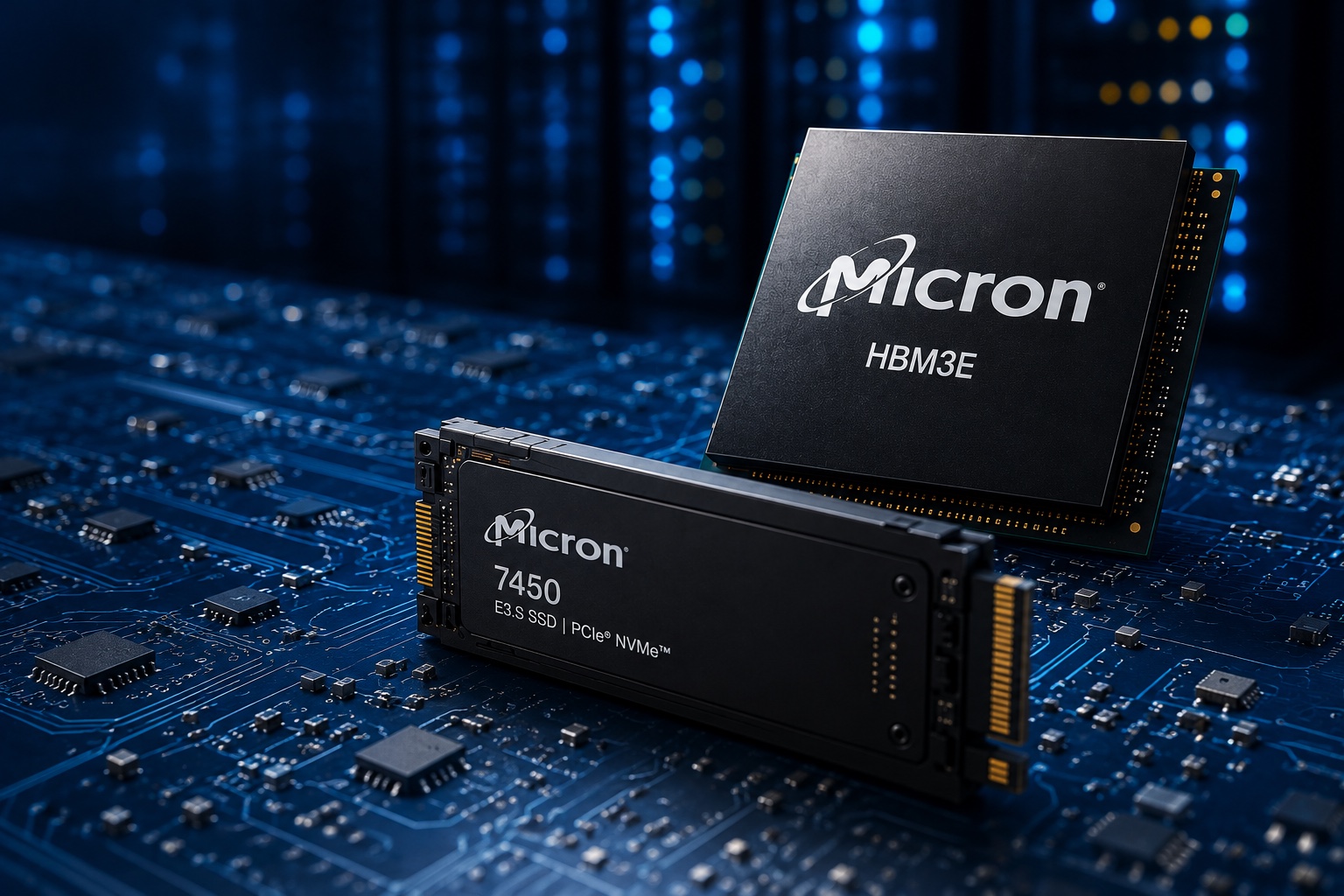
Micron blew past every number on the board. Q3 FY2026 revenue came in at $41.46 billion, beating the company’s own guide of $33.5 billion and a revised consensus near $35.5 billion. Non-GAAP EPS landed at $25.11 versus the guided $19.15. The stock jumped 13-15% in after-hours trading. If you were short premium into this print, you took a loss. If you were long calls or a straddle, you captured a significant move.
- Micron Q3 FY2026 revenue: $41.46B (beat the $33.5B company guide by 24%; beat revised consensus by roughly 18%).
- Non-GAAP EPS: $25.11 vs $19.15 guide, a 31% beat on the company’s own already-aggressive guidance.
- Stock reaction: +13-15% after hours, moving well outside the typical expected move range priced by options markets.
- Q4 FY2026 guidance: $50.0B revenue and $31.00 EPS; HBM demand shows no sign of slowing.
- Options takeaway: this was a directional event, not a volatility play. Iron condors were breached on the upside; long straddles and call spreads captured the move.
The Numbers: What Micron Reported
Micron’s Q3 FY2026 results were not a normal earnings beat. When a company guides to $33.5 billion in revenue and posts $41.46 billion, that is a 24% gap between what management told Wall Street to expect and what they actually delivered. The non-GAAP EPS of $25.11 came in 31% above the company’s own guided $19.15. These are not rounding errors.
| Metric | Company Guide | Revised Consensus | Actual | Beat vs Guide |
|---|---|---|---|---|
| Revenue | $33.5B | ~$35.5B | $41.46B | +$7.96B (+24%) |
| Non-GAAP EPS | $19.15 | ~$20.30 | $25.11 | +$5.96 (+31%) |
| Gross Margin | ~81% | ~82% | ~84.6-84.9% | Well above guide |
| Stock Reaction (AH) | N/A | N/A | +13-15% | Outside expected move |
This was the fifth consecutive quarterly revenue record for Micron. Gross margins expanded to 84.6-84.9% GAAP, up from 37.7% a year earlier. The company simultaneously announced $100 billion in new customer agreements alongside the earnings release.
Why This Happened: The HBM Demand Story
Micron manufactures High Bandwidth Memory (HBM), the specialized memory chips required by AI accelerators like NVIDIA’s H100 and H200 GPUs. Each NVIDIA Blackwell-generation GPU requires HBM chips stacked directly on the package. With hyperscalers, including Microsoft, Google, Amazon, and Meta, investing hundreds of billions in AI infrastructure, demand for HBM has outpaced supply by a wide margin.
Micron’s Q3 earnings confirmed what the AI buildout cycle implied: HBM3E chips are sold out through the end of calendar year 2027, with demand already extending into 2028. The company has layered in HBM4 commitments on top of HBM3E. With supply locked in at premium pricing and new fab capacity still ramping, every unit produced goes out the door at high margin, driving the extraordinary gross margin expansion from 37.7% a year ago to 84.9% this quarter.
The $100 billion in new customer agreements announced alongside earnings signals that this is not a one-quarter demand spike. These are multi-year commitments from hyperscalers that are competing with each other to secure AI infrastructure capacity.
Q4 FY2026 Guidance: The Next Bar
Micron guided Q4 FY2026 to $50 billion in revenue plus or minus $1 billion, with non-GAAP EPS of $31.00 plus or minus $1.00 and gross margins of approximately 86%. To put that in context: the guide they just beat by 24% was $33.5 billion. They’re now guiding the next quarter at $50 billion. That’s a substantial step-up even from the already-high actuals of $41.46 billion.
For options traders watching the forward curve, this guide creates a new baseline for Q4. The market will now price in Micron’s history of beating its own guidance, which means the implied volatility going into the September report will likely reflect elevated uncertainty about whether the guide again captures the full extent of HBM demand.
Options Trader Outcomes: What Worked and What Did Not
Before the Q3 print, Micron’s pre-earnings options were pricing a move of approximately 9-11% based on the at-the-money straddle. The stock moved 13-15% to the upside. Here is how common strategies fared:
Iron Condors: Breached on the Call Side
An iron condor profits when the stock stays within its expected move. With a 13-15% upside gap, any iron condor positioned at or below that level was breached on the call side. As a hypothetical example: if a trader sold the $1,100/$1,150 call spread (positioned above a 10% expected move from a hypothetical $1,050 pre-earnings price) and the stock moved to $1,195, the full width of the call spread would be in play at expiration. Iron condors on Micron were not the right strategy for this print.
This is a useful reminder about semiconductor names during the AI buildout cycle: HBM demand is not easily modeled from the outside, and Micron’s guide-to-actual gaps have been large. For short premium strategies on MU, defined-risk structures that cap the loss at a predictable amount are worth the reduced credit compared to uncapped short strangles.
Long Straddles and Long Calls: Significant Gains
Directional buyers and straddle holders captured the move. A hypothetical long at-the-money straddle entered two weeks before earnings at a cost of approximately $80-100 per share (based on typical MU pre-earnings implied volatility) would have seen intrinsic value at expiration of $130-150 on a 13-15% upside gap, after accounting for the original straddle cost. That is a meaningful return on the premium paid.
Long call spreads, particularly those with strikes targeting 5-10% upside, were also effective. The spread between the long strike and the short strike would have been fully captured on a 13-15% move if both strikes were inside the range of the actual move.
IV Crush: Partially Offset by the Move Size
Despite the large upside move, IV crush on Micron post-earnings was less severe than on a typical modest-beat stock. When a stock gaps 13-15%, the market recalibrates its expectation of future moves upward, which partially offsets the normal post-earnings IV collapse. Traders who sold premium after the initial after-hours gap and into the next session did so at relatively high implied volatility, since the new expected move range was reset higher from the new stock price.
What to Watch Into Q4 FY2026
Micron’s Q4 FY2026 earnings are expected around late September 2026. With revenue guided at $50 billion and the stock resetting 13-15% higher, a few things will set the options setup going into that report:
- Guide-beat expectations are now embedded. Analysts and options markets will assume Micron will again beat its $50 billion guide, raising the implied whisper number. The expected move may not fully account for a second consecutive large beat.
- HBM competitive dynamics matter. Any news about Samsung or SK Hynix gaining HBM share or hyperscaler capex cuts would compress Micron’s pricing power. The bullish case depends entirely on supply constraints holding through 2027.
- Gross margins at 86% leave limited room for expansion. A beat on revenue but a shortfall on gross margin would be a negative surprise, even if the headline revenue number is fine.
For traders using Micron as a recurring earnings play, the current environment favors directional call positioning over neutral short premium, given the AI demand cycle’s tendency to produce asymmetric upside surprises.
Bottom Line
Micron’s Q3 FY2026 report was not a typical earnings beat. A 24% revenue beat versus the company’s own guide, combined with a 13-15% after-hours move, turned every neutral options position into a loss and rewarded directional buyers decisively. The Q4 guidance of $50 billion in revenue suggests the HBM demand cycle has further to run. For options traders, Micron is a name where the AI buildout story is large enough to drive moves outside the implied range, which means strategy selection matters more than just picking a direction.
Frequently Asked Questions
Q: How much did Micron beat earnings by in Q3 FY2026?
A: Micron reported Q3 FY2026 revenue of $41.46 billion, beating the company’s own guidance of $33.5 billion by 24%. Non-GAAP EPS came in at $25.11 versus the guided $19.15, a 31% beat on the company’s own forecast. The stock gained 13-15% in after-hours trading.
Q: What caused the large Micron earnings beat?
A: The primary driver was High Bandwidth Memory (HBM) demand from AI data center buildout. Micron’s HBM3E and HBM4 chips are required by NVIDIA GPU clusters used for AI training. With hyperscalers competing for AI infrastructure capacity, Micron sold every HBM chip it manufactured at premium prices, driving both revenue and gross margin well above guided levels.
Q: What is Micron guiding for Q4 FY2026?
A: Micron guided Q4 FY2026 revenue at $50.0 billion plus or minus $1.0 billion, with non-GAAP EPS of $31.00 plus or minus $1.00 and gross margins of approximately 86%.
Q: What happened to options traders who sold iron condors into the Micron report?
A: Short premium strategies like iron condors were breached on the upside. A 13-15% after-hours gain moved the stock outside the typical 9-11% expected move priced by options markets before the report. Traders who sold call spreads above the expected move range incurred losses proportional to how far in-the-money those spreads moved.
Q: When does Micron report Q4 FY2026 earnings?
A: Micron’s fiscal year ends in late August, with Q4 FY2026 results typically reported in late September 2026. The company has not yet confirmed an official date. Options traders typically begin positioning 3-4 weeks before the report date, when pre-earnings implied volatility starts to expand.
Keep learning: Before this report, Micron’s pre-earnings options setup laid out the expected move and strategy framework. Read the Micron Q3 FY2026 pre-earnings analysis to see how the actual results compared to the pre-print setup, including the HBM demand thesis and the expected move calculation.