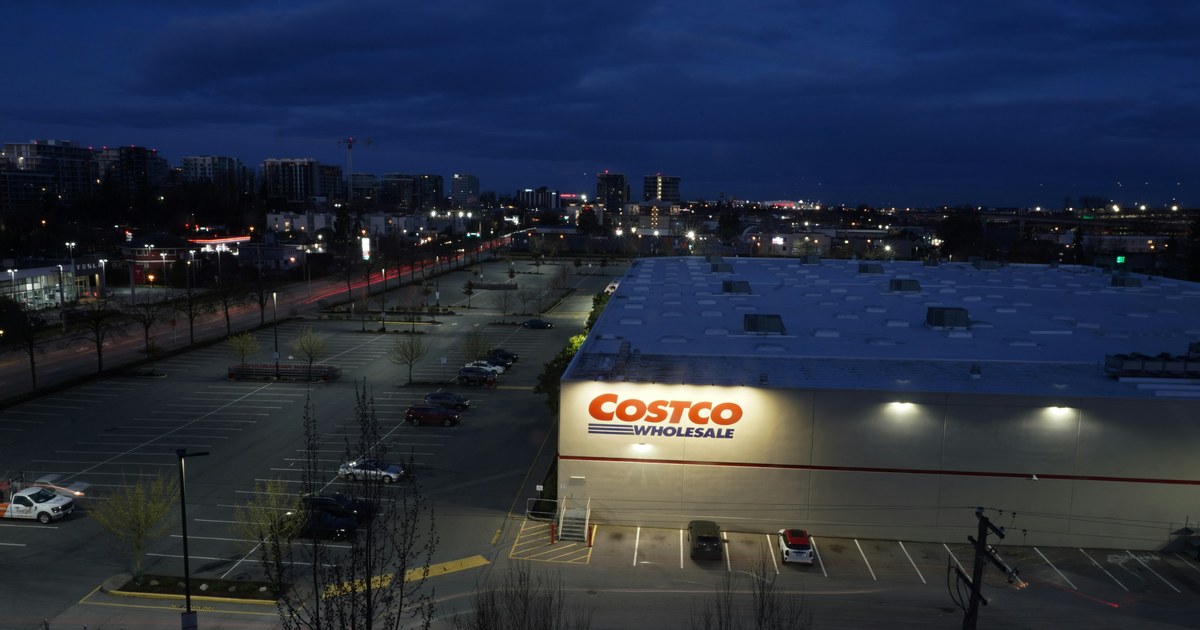
Costco reports fiscal Q4 2026 results on Thursday, September 24, after the market closes, with a 2:00pm PT call. Analyst consensus sits around $6.54 EPS and $94.5 billion in revenue, roughly 10% revenue growth year over year. But the number that usually matters more for this stock isn’t the headline print: it’s the membership renewal rate, and Costco’s options market has learned to price this name for calm more often than not.
Key Takeaways
- Costco reports fiscal Q4 2026 earnings Thursday, September 24, 2026, after market close (2:00pm PT call), confirmed via Costco’s own investor relations events page.
- Consensus estimates cluster around $6.51 to $6.56 EPS and $94.2 to $94.9 billion in revenue (approximately 10% year-over-year growth).
- Costco has beaten EPS estimates in five consecutive quarters, but the stock has historically delivered smaller post-earnings moves than semiconductor or high-growth tech names.
- Membership renewal rate and digitally-enabled comparable sales are the two figures that tend to move this stock more than the EPS beat or miss itself.
- All strategy examples below are hypothetical and illustrative only, not trade recommendations.
Why Costco Trades Differently Than Other Retail Earnings
Retail earnings season already has two distinct clusters on this site: big-box general merchandise (Home Depot, Lowe’s, Target, TJX, Walmart) and trade-down dollar stores (Dollar Tree, Dollar General). Costco is neither. Its membership-fee model means the company collects recurring, high-margin revenue before a single item is scanned at checkout, and its bulk-purchase mechanics attract a different income cohort than a dollar-store shopper trading down or a home-improvement buyer reacting to mortgage rates.
That structural difference shows up in how the stock trades around earnings. Because membership fees are largely locked in for the year, a single quarter’s merchandise sales miss rarely derails the overall thesis the way it might for a pure retailer. Options prices reflect that: Costco’s historical implied moves around earnings have often landed in the 2.6% to 3.4% range, well below the double-digit moves this site has covered around AI-hardware or semiconductor prints (AVGO, NVDA, SMCI).
The two numbers that matter more than the EPS beat
Two metrics from Costco’s own reporting have repeatedly moved the stock more than the top-line beat or miss:
- Membership renewal rate. As of Costco’s fiscal Q3 2026 report, the U.S. and Canada renewal rate stood at 92.2%, up 10 basis points from the prior quarter, while the worldwide rate held at 89.7%. Management has noted that online-only sign-ups renew at slightly lower rates than warehouse enrollments, a mix shift worth watching as digital adoption grows. A meaningful dip in either renewal figure tends to draw more analyst attention than a few cents of EPS variance.
- Digitally-enabled comparable sales. Costco’s e-commerce comp reached +21.5% in fiscal Q3 2026, its strongest quarterly e-commerce comp in recent memory, alongside a reported 37% increase in e-commerce and app traffic. Whether that pace holds or decelerates in Q4 is one of the more closely watched threads heading into this print.
How to Read the Expected Move Into September 24
With the report still more than a week away, the front-week at-the-money straddle that determines the market’s actual priced-in move for this specific quarter isn’t set yet. That number firms up in the final few trading days before the print, since it responds directly to how implied volatility builds into the event. Rather than guessing at a number that will look outdated by the time you read this, here’s the mechanic to check yourself close to the report date:
- Pull the front-week options chain for the Friday expiration closest to (or immediately following) September 24.
- Find the at-the-money call and put at the strike closest to Costco’s current price.
- Add the two premiums together and multiply by roughly 0.85. That figure, as a percentage of the stock price, is the market’s expected move.
Given Costco’s own recent history of 2.6% to 3.4% realized post-earnings moves, a straddle pricing in something notably higher than that range this cycle would itself be a signal that the market expects more uncertainty than usual, worth noting before assuming this quarter behaves like a typical Costco print.
Strategy Framing for a Historically Low-Volatility Name
Costco’s tendency toward smaller realized moves changes which options strategies make sense around its earnings compared to a high-IV name. The table below compares four illustrative approaches purely to show how the risk profile shifts, not as a recommendation for any specific trade.
| Strategy (hypothetical) | View | Works well if | Key risk |
|---|---|---|---|
| Iron condor around the expected move | Neutral, expects a contained move | Costco delivers its typical sub-3.5% move | A larger-than-usual surprise (renewal rate miss, guidance cut) can blow through both wings |
| Cash-secured put below support | Willing to own shares at a discount | A modest pre-earnings pullback creates an attractive entry level | Ties up significant capital given Costco’s high per-share price |
| Long straddle or strangle | Expects a bigger move than history suggests | You have a specific reason to expect renewal rates or e-commerce comps to surprise sharply | Historically expensive relative to Costco’s realized moves; IV crush after the print works against the position even on a correct directional call |
| Covered call on existing shares | Neutral to mildly bullish, income-focused | You already hold shares and want to collect premium through a historically calm event | Caps upside if Costco does deliver a larger-than-typical positive surprise |
A hypothetical trader who has watched Costco grind through five consecutive earnings beats without runaway stock reactions might lean toward the iron condor or covered call framing precisely because the historical pattern favors a contained move. A hypothetical trader who believes this quarter’s renewal-rate mix shift (more online sign-ups renewing at lower rates) is about to become a real headwind might instead prefer a defined-risk long premium position, accepting the higher cost of buying volatility on a name that doesn’t usually deliver it.
What Would Actually Move This Stock More Than Usual
Given the setup, a few specific outcomes would be more likely than a routine EPS beat to produce a larger-than-typical reaction:
- A renewal rate decline in either the U.S./Canada or worldwide figure, rather than the recent pattern of flat-to-improving numbers.
- A deceleration in digitally-enabled comps well below the +21.5% pace set in fiscal Q3, suggesting the e-commerce growth story is cooling.
- Any commentary on membership fee increases or timing, since Costco’s last fee increase materially affected membership fee income growth and investors watch for signals on the next one.
- Guidance or commentary on tariff-related merchandise cost pressure, a theme that has affected multiple retailers this earnings season.
Bottom Line
Costco’s options market prices this name for a smaller move than most of the earnings setups covered on this site, and its own recent history (five straight EPS beats, stable-to-improving renewal rates) supports that pricing. The renewal rate and e-commerce comp figures are worth checking against Costco’s own investor relations release when it lands on September 24, since either one drifting from its recent trend is a more meaningful signal than the EPS line alone.
FAQ
Q: When does Costco report fiscal Q4 2026 earnings?
A: Thursday, September 24, 2026, after market close, with a 2:00pm PT earnings call, per Costco’s own investor relations events page.
Q: What is the consensus estimate for Costco’s Q4 FY2026 earnings?
A: Analyst estimates cluster around $6.51 to $6.56 per share on revenue of roughly $94.2 to $94.9 billion, about 10% revenue growth year over year. Check a live earnings-estimate source closer to the report date, since consensus figures can shift in the final days before a print.
Q: Why does Costco’s stock usually move less than other retailers after earnings?
A: Membership fees make up a recurring, high-margin revenue base that isn’t directly tied to a single quarter’s merchandise sales, which tends to dampen the market’s reaction to any one quarter’s results. Historical post-earnings moves for Costco have often landed in the 2.6% to 3.4% range.
Q: What is Costco’s current membership renewal rate?
A: As of fiscal Q3 2026, the U.S. and Canada renewal rate was 92.2% and the worldwide rate was 89.7%. Watch Costco’s Q4 release for whether these figures held, improved, or declined.
Q: Is a long straddle a good way to trade Costco earnings?
A: That depends entirely on your own view and risk tolerance, and this isn’t a recommendation either way. Long premium strategies tend to be more expensive relative to Costco’s typically contained realized moves, which is a real cost to weigh against any expectation of an unusually large surprise this quarter.
Keep Learning
For the mechanics behind the expected-move calculation used above, see how to find the expected move before earnings. For a broader look at this earnings season’s retail cluster, see retail earnings week options setups.