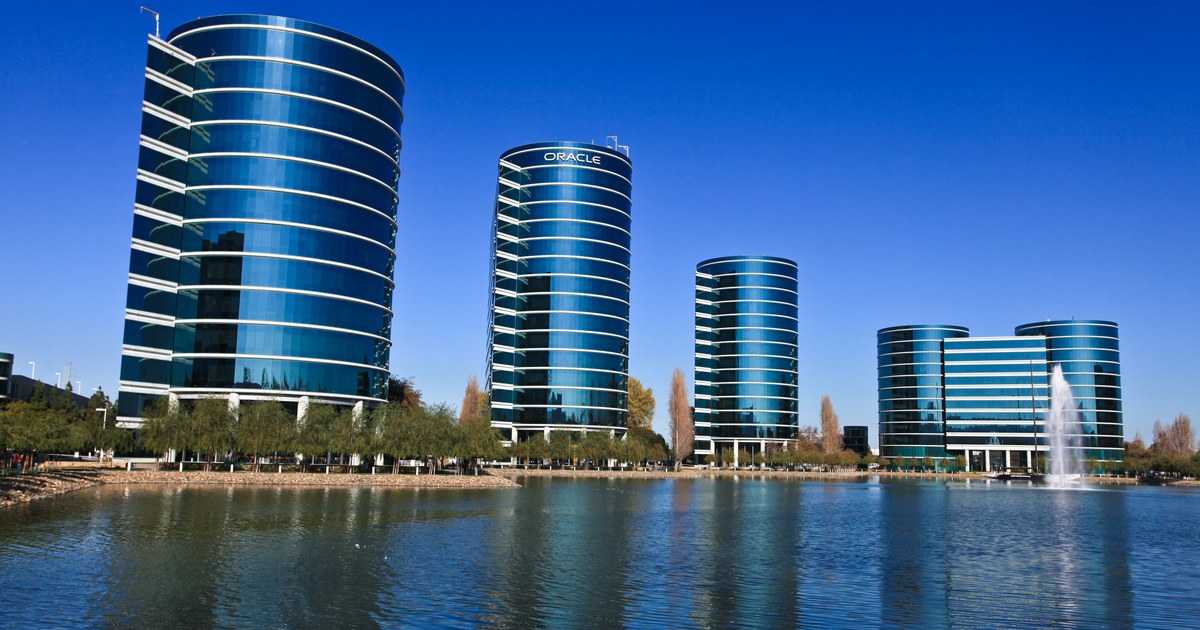
Oracle beat on both lines Thursday, EPS of $1.92 against a $1.74 consensus, revenue of $19.3 billion against $19.14 billion expected, and cloud infrastructure revenue more than doubled, up 121% year over year to $7.4 billion. The stock still closed down 5.4% into the print, then reversed to roughly +4.1% in after-hours trading once the numbers landed. The options market had priced an 11%-to-12% move either way. The actual after-hours reaction came in well inside that range, a reminder that “implied move” measures uncertainty, not the size of the move that actually happens.
Key Takeaway
- Oracle reported fiscal Q1 2027 results Thursday, September 10, 2026, after market close: non-GAAP EPS of $1.92 (vs. $1.74 consensus) on revenue of $19.3 billion (vs. $19.14 billion consensus), both beats.
- Cloud infrastructure revenue surged 121% year over year to $7.4 billion; total cloud revenue rose 62% to $11.6 billion, Oracle’s ninth straight quarter of infrastructure revenue acceleration.
- Oracle raised full-year fiscal 2027 guidance to at least $90 billion in revenue (34% constant-currency growth) and non-GAAP EPS of $8.10.
- The options market had priced an implied move of roughly 11.2%-11.8%. The stock closed the regular session down 5.4%, then moved back up about 4.1% in after-hours trading once results were digested, a smaller net reaction than the priced-in range implied.
- All examples below are hypothetical and illustrative, not trade recommendations.
What Oracle Actually Reported
Oracle’s fiscal Q1 2027 results, confirmed via the company’s own investor relations release, beat Wall Street on every headline metric. Non-GAAP EPS came in at $1.92, a 30% year-over-year increase and well above the $1.74 consensus that had been built from Oracle’s own guided range of $1.72-$1.76. Revenue reached $19.3 billion, up 30% year over year and above the $19.14 billion analysts had modeled.
The number that mattered most to the stock’s after-hours move was cloud infrastructure: revenue there jumped 121% year over year to $7.4 billion, extending what Oracle described as its ninth consecutive quarter of infrastructure revenue acceleration. Total cloud revenue, infrastructure plus applications, rose 62% to $11.6 billion. GPU utilization reached 97.9%, and the company added 850 megawatts of data center capacity during the quarter, both figures management pointed to as evidence that the AI-driven capacity buildout is converting into booked, billable demand rather than sitting idle.
| Metric | Analyst consensus | Actual result |
|---|---|---|
| Non-GAAP EPS | ~$1.74 | $1.92 (beat) |
| Total revenue | ~$19.14B | $19.3B (beat) |
| Cloud infrastructure revenue growth (YoY) | Not separately consensus-tracked | +121% |
The Guidance Raise: Oracle’s Own Bar Just Moved Higher
Oracle raised its full fiscal year 2027 outlook to at least $90 billion in total revenue, representing 34% constant-currency growth, and non-GAAP EPS of $8.10, up from a prior $8.05 after adjusting for a prior-year investment gain. Management also disclosed over $30 billion in new AI cloud contracts booked during the quarter alone, a bookings figure that speaks to future revenue recognition rather than this quarter’s results, but one the market treated as evidence that the growth story has runway beyond the current print.
Raising guidance immediately after a beat quarter is the more demanding path for a company to take: it resets the bar higher for the very next report, rather than banking the current quarter’s outperformance as cushion. For a stock that closed down into the print on capex-cost concerns, a credible bookings and guidance raise is a more direct answer to the market’s worry than the trailing EPS number alone.
Why the Stock Fell Into the Print, Then Reversed After It
ORCL closed the regular session down 5.38% at $152.94, continuing pre-earnings jitters over the pace and cost of Oracle Cloud Infrastructure’s data center buildout, the same concern that drove an 8.52% decline after Oracle’s June 2026 print (covered in TRDC’s Q4 FY2026 recap). Once results actually landed, the stock moved to roughly $159, up about 4.1% in after-hours trading, as the combination of the EPS/revenue beat, the 121% infrastructure growth number, and the raised guidance outweighed the capex-cost worry that had pressured shares into the close.
The options market had priced an implied move of roughly 11.2% (front-week, per TipRanks/the Fly) to 11.78% (per OptionsLam), meaning a straddle bought at that pricing would have needed the stock to move beyond that range, in either direction, to profit net of the premium paid. The after-hours reversal, a 5.4% decline followed by a roughly 4.1% bounce, produced meaningful two-way movement without ultimately traveling as far net as the priced-in range implied. That’s a useful data point against Oracle’s own longer history: the stock’s last four post-earnings reactions before this one averaged 16.12% in absolute terms, so this print landing calmer than both that historical average and the priced-in move is itself notable, not merely “a quiet quarter.”
Illustrative Structures Around an Earnings Event Like This
The three structures below are the standard menu traders consider around an event like Oracle’s report. None of these are recommendations, they’re illustrations of how each structure would have behaved relative to what actually happened, using this report purely as a worked example after the fact.
| Structure | Directional view | Max risk | How it would have fared here |
|---|---|---|---|
| Long straddle (buy ATM call + ATM put) | None (pure volatility bet) | Premium paid | Likely a loss: the net after-hours move undershot the ~11% implied move, and IV crush works against a long-premium position even when the stock does move somewhat |
| Long strangle (buy OTM call + OTM put) | None (cheaper volatility bet) | Premium paid | Similarly challenged, cheaper entry but strikes set further out, needing an even bigger move than the straddle to profit |
| Short iron condor (sell OTM call spread + OTM put spread) | None (bets the move stays contained) | Width of the wider spread minus credit collected | Likely favorable if strikes were set near or beyond the implied 11% range, since the realized move landed inside it and IV crush compresses the credit side’s remaining premium |
This is the pattern worth sitting with: Oracle’s options market has, in this instance, priced a bigger move than what actually happened. That doesn’t mean options are always “overpriced” into Oracle earnings, the June 2026 print moved further than its own implied range did. It means the relationship between implied and realized moves varies print to print, which is exactly why position sizing and defined-risk structures matter more than trying to predict which way a single quarter breaks.
The IV Crush Mechanic This Report Illustrates
Implied volatility on ORCL options was elevated heading into Thursday’s report and collapsed once results were out, the standard pattern known as IV crush. A long straddle or strangle bought the morning of the report would have been fighting that collapse from the moment the print landed: the options lose extrinsic value from the IV drop faster than they gain intrinsic value from the stock’s move, unless that move happens immediately and decisively enough to outrun the crush. Premium sellers on the other side of that same trade get compensated for absorbing exactly that risk.
If you’re new to this mechanic, TRDC’s guide to trading options around earnings walks through the straddle and strangle math, the IV crush problem, and how premium sellers think about entry timing in more depth than fits here.
Bottom Line
Oracle beat on EPS, revenue, and its central AI-infrastructure growth metric, then raised full-year guidance on top of it, and the stock still spent most of Thursday’s regular session lower before recovering after hours once the numbers landed. The options market’s ~11% implied move proved wider than what the after-hours reaction actually delivered, a useful reminder that a name with real capex-cost overhang can beat cleanly and still take time to convince the market the concern is resolved.
FAQ
Q: What were Oracle’s actual Q1 FY2027 earnings results?
A: Non-GAAP EPS of $1.92 (vs. $1.74 consensus) on revenue of $19.3 billion (vs. $19.14 billion consensus), both beats, reported Thursday, September 10, 2026, after market close.
Q: How did Oracle’s stock react to earnings?
A: Shares closed the regular session down 5.38% at $152.94 on pre-earnings capex concerns, then rose roughly 4.1% in after-hours trading to about $159 once results and raised guidance were digested.
Q: Did the stock move more or less than the options market expected?
A: Less, net. The options-implied move was roughly 11.2%-11.8%; the after-hours reaction of about 4.1% landed well inside that range, even accounting for the intraday decline that preceded it.
Q: What drove Oracle’s cloud infrastructure growth this quarter?
A: Cloud infrastructure revenue rose 121% year over year to $7.4 billion, Oracle’s ninth consecutive quarter of infrastructure revenue acceleration, with GPU utilization at 97.9% and 850 megawatts of new data center capacity added, plus over $30 billion in new AI cloud contracts booked during the quarter.
Q: Do options prices always fall after an earnings report?
A: Implied volatility typically drops sharply right after the event regardless of how the stock moves, a pattern known as IV crush, since the uncertainty the options were pricing has now resolved. This affects long option positions negatively and short option positions positively, independent of which way the stock goes.